


Every backyard eventually needs a signature game. The one that comes out for every cookout, every visiting cousin, every evening when the sun is still up after dinner. Bocce ball and cornhole are two of the most requested options for that role, and if you have never played either, picking between them can feel harder than it should be.
Here is the good news: they are not really competing for the same moment. Once you know how each one plays, the choice mostly makes itself.
What Is Bocce Ball? 
Bocce is an Italian lawn game that has been played for centuries, and its basic idea has not changed much in all that time. One player tosses a small target ball, called the pallino, down the court. Players or teams then take turns rolling their own larger balls, trying to land as close to the pallino as possible. Closest ball at the end of the round scores points, and the game usually plays to 12 or 13.
Bocce rewards a soft touch. There is no throwing hard or aiming for distance, just careful rolling and reading the terrain. That makes it one of the rare games where a six-year-old and a grandparent can play the same round on genuinely even footing. It also needs real room: a proper bocce court runs 60 to 90 feet, though most backyard versions get played on whatever stretch of lawn is available.
What Is Cornhole?
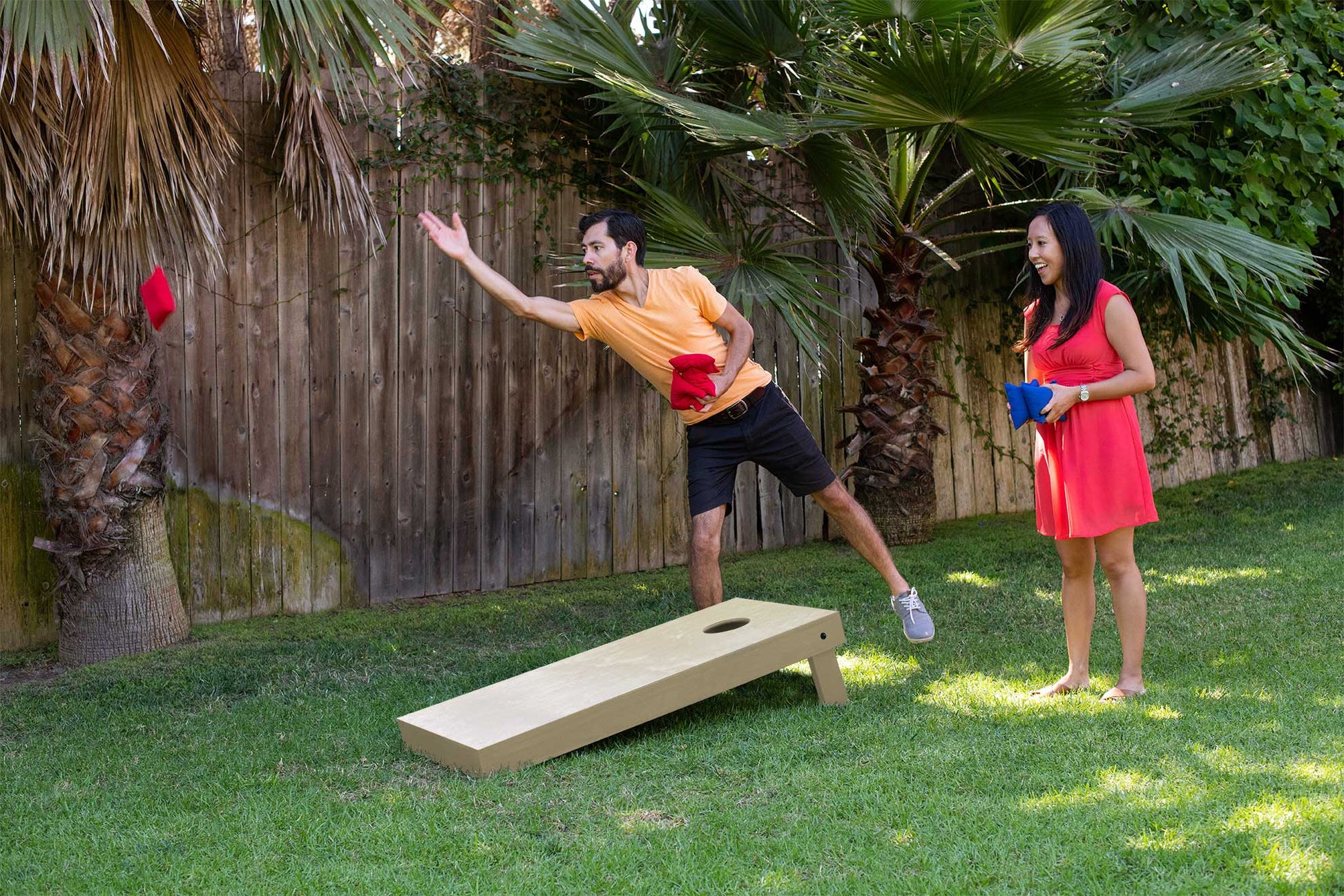
Cornhole is the more familiar name in American backyards, and its rules are almost as simple. Two angled boards sit 27 feet apart, each with a hole cut near the top. Players take turns tossing bean bags at the opposing board, scoring one point for a bag that lands on it and three points for a bag through the hole. First team to 21 wins.
Where bocce is about touch, cornhole is about repetition and a bit of arm strength. It plays fast, it is easy to pick up in one round, and it does not ask for much space between tosses since players stand right next to their board.
Bocce Ball vs Cornhole: The Real Differences
The two games split along a few practical lines that matter more than most reviews mention.
Space. Cornhole needs a straight 27-foot lane and not much else. Bocce wants width as well as length, since balls roll and drift. If your yard is narrow or broken up by a patio, cornhole is the easier fit.
Age range. Cornhole's toss is forgiving for older kids but can be tough for a four or five-year-old to land consistently. Bocce's rolling motion is easier for small hands and older adults alike, which is part of why it has stayed a multigenerational favorite for so long.
Setup and storage. Cornhole boards are the bulkier of the two, even the folding versions. Bocce sets pack into a small bag and travel well to a park or the beach.
Pace. Bocce rounds take longer to develop as balls get nudged and knocked around. Cornhole moves quickly, which is part of why it dominates tailgates and quick backyard sessions.
Surface. Bocce plays best on packed dirt, sand, or short grass, since a bumpy lawn knocks balls off course. Cornhole is more forgiving here because the boards create their own flat surface, so the ground underneath barely matters.
Skill ceiling. Bocce hides real strategy under its simple rules. Skilled players learn to knock an opponent's ball off target or block a lane, which gives the game depth after a family has played it a few dozen times. Cornhole's ceiling comes down mostly to a consistent toss rather than tactics.
Neither one is the better game. They are built for different afternoons.
A Third Option Worth Knowing

Bocce and cornhole are the two names most people already have in their head, which is exactly why it is worth knowing about a third option before you buy either one: Rockin' Pockets. It is not a version of cornhole or a stand-in for bocce. It solves a different problem than either one does, and that problem comes up more often than you might expect.
It fits in tighter spaces than both. Regulation cornhole wants a straight 27-foot lane. A real bocce court runs 60 to 90 feet. Rockin' Pockets needs neither. The two bases sit close enough together to fit on a standard patio or a narrow side yard, which matters if your outdoor space is not built for a long, straight throwing lane in either direction.
It removes the waiting. This is the biggest functional difference from cornhole. In cornhole, one player tosses while everyone else stands and watches, then it is the next person's turn. Rockin' Pockets has both players toss at the same time, every round. For a competitive kid, that is the difference between a game that feels active the whole way through and one where half the game is spent standing on the sideline.
It gives instant, physical feedback. The base rocks and tilts toward whoever is winning as bags land, so a player can see and feel the score shifting in real time instead of waiting to count up bags at the end of a round. That immediate feedback loop is what tends to hook kids who find bocce's slower, quieter pace a little too patient for their taste, without needing cornhole's longer lane or its stand-and-wait structure to get there.
Rounds move fast. First to 25 points wraps up quickly, similar to cornhole's pace and noticeably faster than a full game of bocce. For a kid who wants a rematch immediately, that turnaround matters.
None of that makes Rockin' Pockets better than bocce or cornhole. It just means if your yard is tight, your kids want constant action instead of turns, or you are torn between the two classics, there is a real third path that was built to solve exactly that.
Which One Should You Actually Get?
If your crew is heavy on toddlers and grandparents, bocce is the safer bet. Everyone can roll a ball, nobody needs to throw hard, and a full set costs less than most single cornhole boards.
If you have the space for a full 27-foot lane and want the most familiar backyard classic, cornhole is the tried-and-true pick. It is the game most guests already know how to play without an explanation.
If your space is tighter than either classic game wants, or your kids are competitive and get restless waiting their turn, Rockin' Pockets is worth a look. It was built for exactly that gap: a smaller footprint, constant action for both players, and a physical, visible way to track who is winning as the game happens.
Plenty of families end up owning more than one. Bocce comes out for the slow Sunday dinners when there is nowhere to be and the point is to linger. Rockin' Pockets comes out when the kids want something faster and louder, or when the yard is not big enough for a full cornhole lane. There is no wrong answer here, only a better fit for the space and the crowd you actually have. Either way, the goal is the same: get everyone off their screens and standing in the grass together.


